
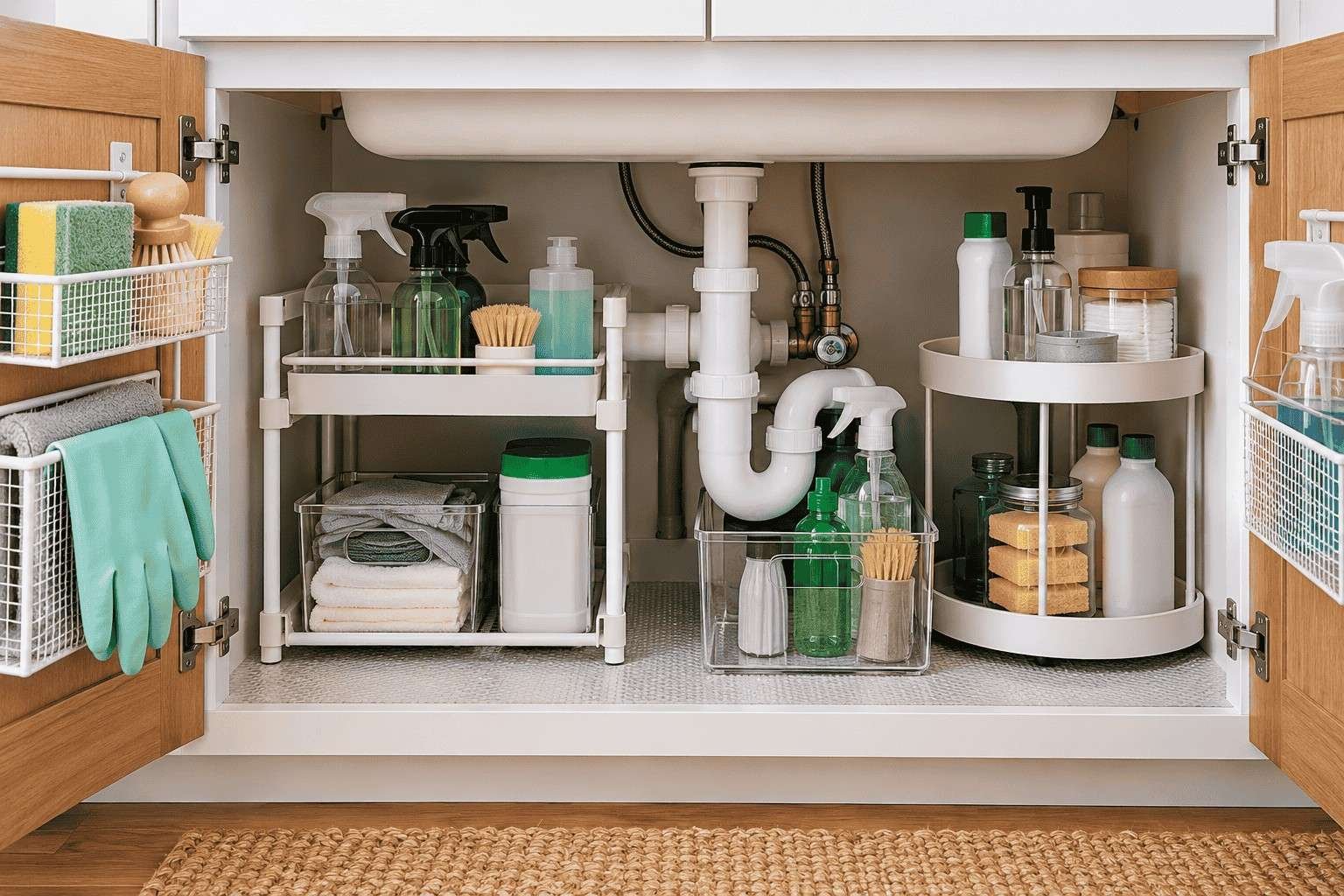
Under sink organization ideas can make one of the most frustrating spaces in your home much easier to use and maintain.
The plumbing takes up valuable room. The P-trap gets in the way. Tall bottles tip over, small cleaning supplies disappear into the back, and every time you need something, you seem to pull out three other things first.
The good news? You don’t need a perfectly shaped cabinet to create useful storage.
The key is to organize around the plumbing instead of trying to ignore it.
These 15 under-sink organization ideas will help you make better use of awkward cabinet space while keeping everyday supplies easy to reach and important plumbing accessible.
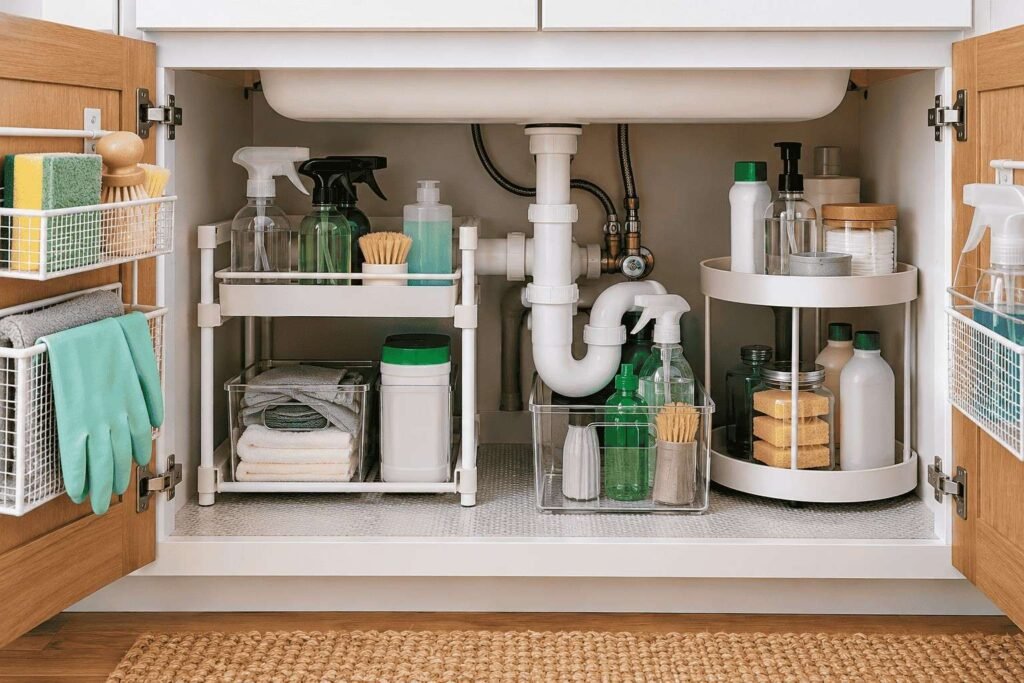
Before You Organize: Measure Around the Pipes
Before buying an organizer, take a few minutes to understand the space you’re actually working with.
Don’t measure only the cabinet width. Pay attention to:
- The width available on each side of the plumbing
- The height below and above the pipes
- The depth of the cabinet
- The position of the P-trap
- The location of shutoff valves
- The space needed to access plumbing later
A beautiful organizer isn’t useful if it blocks the pipes or doesn’t fit around them.
Think of your cabinet as several smaller storage zones rather than one large empty box.
For another practical look at organizing awkward under-sink space, see IKEA’s under-sink organization guide.
15 Under Sink Organization Ideas That Actually Work Around Pipes
1. Split Storage Around the P-Trap
If your plumbing runs through the center of the cabinet, don’t try to force one large organizer into the entire space.
Instead, use the areas on either side of the pipe.
Small bins, narrow organizers, or separate storage containers can create two useful zones without blocking the plumbing.
Best for: Cabinets with a large center pipe or P-trap.
Product type to consider: Narrow or adjustable organizers.
Amazon opportunity: See a similar under-sink organizer on Amazon.
2. Use an Adjustable Two-Tier Organizer
Under-sink cabinets often have more vertical space than horizontal space.
A two-tier organizer can help you use that height while keeping smaller items visible.
Look for adjustable designs when possible so the shelves can be positioned around your plumbing instead of directly through it.
Place frequently used items on the easier-to-reach level and less frequently used supplies higher or farther back.
Best for: Cabinets with unused vertical space.
Product type to consider: Adjustable two-tier under-sink organizer.
Amazon opportunity: Check the current adjustable organizer options on Amazon.
3. Add a Pull-Out Organizer
Deep cabinets create another common problem: everything gets pushed toward the back.
A pull-out organizer solves this by bringing the contents forward instead of making you reach around bottles.
This can be especially helpful for heavier cleaning supplies or products that you don’t use every day.
Before purchasing one, make sure the mechanism and dimensions work with your cabinet and plumbing layout.
Best for: Deep cabinets where the back is difficult to reach.
Product type to consider: Pull-out under-sink drawer or organizer.
4. Use Two Narrow Bins Instead of One Large Bin
One oversized storage bin may seem like the easiest solution, but it can waste the awkward space created by pipes.
Two smaller bins can be positioned on either side of the plumbing and removed individually.
Use one for everyday cleaning supplies and another for less frequently used items.
This also makes it easier to take out one category without disturbing everything else.
Best for: Cabinets divided by plumbing.
Product type to consider: Small or narrow storage bins.
5. Turn the Cabinet Door Into Storage
The inside of the cabinet door is often completely unused.
A slim door-mounted basket or organizer can hold lightweight items such as cleaning cloths, sponges, scrub brushes, and gloves.
Keep heavier bottles off the door unless the organizer and cabinet are specifically designed to support the weight.
Best for: Small items that are currently taking up shelf space.
Product type to consider: Slim adhesive or mounted door organizer.
Amazon opportunity: Shop a similar cabinet-door storage solution on Amazon.
6. Hang Spray Bottles From a Tension Rod
If you have enough clearance above your supplies, a tension rod can create simple vertical storage for spray bottles.
Instead of letting bottles stand across the entire cabinet floor, hang them by their trigger handles.
This leaves the floor underneath available for bins or other supplies.
Just make sure the rod is securely positioned and doesn’t interfere with the cabinet doors or plumbing.
Best for: Spray-heavy cleaning collections.
Product type to consider: Adjustable tension rod.
7. Create a Dedicated Cleaning-Supply Zone
Organization becomes easier when every item has a logical home.
Instead of putting products wherever they fit, create simple zones.
- Zone 1: Everyday cleaning products
- Zone 2: Dishwashing supplies
- Zone 3: Cloths and gloves
- Zone 4: Backup products
This makes the cabinet easier to maintain because you’re not deciding where something belongs every time you put it away.
If you’re organizing other small kitchen spaces too, you may also like our Small Pantry Organization Ideas for more practical ways to maximize limited storage.
8. Use Small Bins for Loose Items
Tiny items are usually the first things to disappear inside a deep cabinet.
Small bins can keep items such as sponges, gloves, replacement brushes, and dishwasher supplies together.
Choose bins that are easy to lift out so you can quickly see what you have.
Clear or open-front containers can be especially useful when you want to see the contents without searching.
Best for: Small supplies that tend to get scattered.
Product type to consider: Small clear storage bins or caddies.
Amazon opportunity: See similar under-sink storage bins on Amazon.
9. Add a Compact Lazy Susan
Corners are difficult to use when bottles and containers are packed tightly together.
A compact lazy Susan can make smaller products easier to reach without requiring you to move everything in front of them.
It’s particularly useful for items you use regularly but don’t want sitting at the front of the cabinet.
Before buying one, check the available clearance around the plumbing.
Best for: Awkward corners and smaller bottles.
Product type to consider: Compact under-sink lazy Susan.
10. Use an Adjustable Shelf Above the Plumbing
If your cabinet has unused space above the pipes, an adjustable shelf can create another storage level.
The important part is leaving enough clearance for the plumbing underneath.
Use the upper area for lighter or less frequently used supplies while keeping the lower area accessible.
Best for: Cabinets with significant vertical clearance.
Product type to consider: Adjustable under-sink shelf.
11. Protect the Cabinet Floor With a Water-Resistant Liner
Organization isn’t only about storage.
The cabinet underneath a sink is also vulnerable to drips, spills, and small leaks.
A removable water-resistant liner can make cleanup easier and help protect the cabinet surface.
Choose a liner that can be removed and cleaned rather than permanently trapping moisture underneath.
Best for: Kitchens and bathrooms where spills are common.
Product type to consider: Waterproof or water-resistant cabinet liner.
Amazon opportunity: Check current cabinet-liner options on Amazon.
12. Add Motion-Activated Lighting
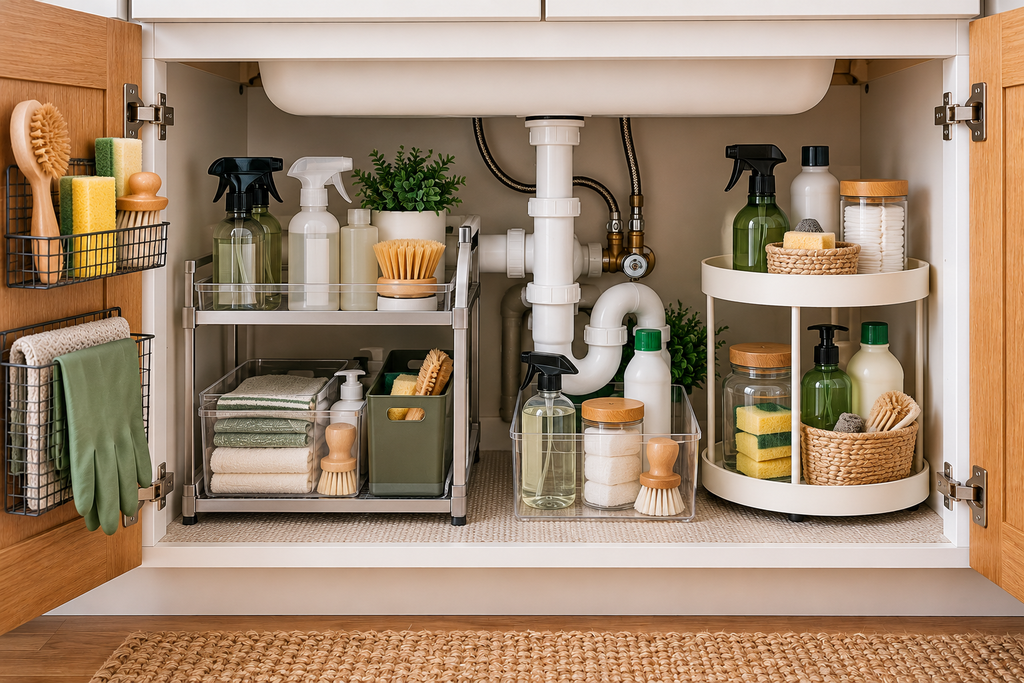
Even a perfectly organized cabinet can be annoying if you can’t see what’s inside.
A small motion-activated light can make dark cabinets much easier to use.
It is especially helpful for finding small products toward the back without having to hold a flashlight or turn on another light.
Best for: Dark cabinets and deep storage areas.
Product type to consider: Compact motion-sensor cabinet light.
13. Keep a Clear Maintenance Zone
This is one of the most important rules for under-sink organization: Never organize so tightly that you can’t reach the plumbing.
Keep shutoff valves, pipes, and important connections accessible.
You may never need to touch them during normal use, but when something leaks or needs maintenance, you’ll be glad you left a clear path.
Avoid permanently stacking heavy containers directly in front of plumbing connections.
14. Use Narrow Storage for Small Cabinets
A small cabinet doesn’t need a large organizer.
In fact, oversized organizers can make a small cabinet harder to use.
Instead, look for narrow storage that matches the actual available space around your plumbing.
A combination of one narrow organizer, a small bin, and door storage may work better than one large multi-compartment unit.
Best for: Small kitchens, bathrooms, and compact vanities.
Product type to consider: Narrow under-sink organizers and compact bins.
15. Create a Simple Reset System
The best organization system is one you can maintain.
Once everything has a home, create a quick reset routine.
- Remove empty products.
- Return items to their assigned zones.
- Wipe up dust or spills.
- Check that plumbing remains accessible.
- Move frequently used products toward the front.
- Avoid keeping duplicates you don’t actually need.
A five-minute reset can prevent the cabinet from slowly turning back into a storage dump.
How to Choose the Right Under-Sink Organizer
Instead of asking, “Which organizer is best?” start with the problem you’re trying to solve.
| Your problem | Storage solution to consider |
|---|---|
| Center pipe takes up space | Split or pipe-friendly storage |
| Deep cabinet | Pull-out organizer |
| Lots of vertical space | Two-tier organizer |
| Small cabinet | Narrow bins or organizers |
| Unused cabinet door | Door-mounted basket |
| Too many spray bottles | Tension rod |
| Hard-to-reach corner | Compact lazy Susan |
| Dark cabinet | Motion-activated light |
| Cabinet floor gets messy | Removable water-resistant liner |
The right organizer is the one that works with your cabinet layout, not simply the one that looks best in a product photo.
Common Under-Sink Organization Mistakes
Buying Before Measuring
The biggest mistake is purchasing an organizer before checking the actual usable space.
Plumbing can dramatically change the amount of room available.
Blocking the Plumbing
Storage should make the cabinet more functional—not make future maintenance difficult.
Always leave access around important plumbing connections.
Using One Giant Storage Bin
One large container can quickly become a black hole.
Smaller zones usually make it easier to see, remove, and return items.
Ignoring Vertical Space
If everything sits on the cabinet floor, you’re probably leaving usable space above it.
Look upward and consider shelves, tiers, or hanging storage.
Keeping Too Many Products
Organization can’t fix an overcrowded cabinet.
If you have several nearly identical products, expired cleaners, or things you never use, removing them may create more space than buying another organizer.
How to Keep Your Under-Sink Cabinet Organized
Once you’ve created your zones, keep the system simple.
Use the 5-minute reset: Remove → Return → Wipe → Check → Restock.
Remove empty products.
Return everything to its assigned zone.
Wipe away spills and dust.
Check that pipes and shutoff valves are still accessible.Copy
Then restock only what you actually need.Copy
This small routine makes it much easier to keep the cabinet organized long term.
Final Thoughts
These under sink organization ideas can help you make even an awkward cabinet more functional without fighting the plumbing.
The trick is to work around the plumbing instead of fighting it.
For more practical ideas for making small spaces easier to manage, explore our home organization ideas at Homely Mint.
Start by measuring the usable space, identify what is making the cabinet difficult to use, and then choose storage that solves that specific problem. Copy
These under sink organization ideas are designed to make awkward cabinet space easier to use without blocking your plumbing.
Whether you need a pull-out organizer, narrow bins, door storage, or simply a better system for dividing supplies, the goal is the same: Everything should be easy to find, easy to put away, and easy to access when the plumbing needs attention.
Frequently Asked Questions
How do I organize under my sink with pipes?
Start by measuring the space around the pipes and P-trap. Then divide the cabinet into smaller zones using narrow organizers, bins, shelves, or pull-outs that leave the plumbing accessible.
What is the best way to organize around a P-trap?
Avoid forcing one large organizer into the cabinet. Splitting storage into smaller zones on either side of the P-trap can make better use of the available space.
What should I store under my kitchen sink?
Common choices include cleaning supplies, dishwashing products, sponges, cloths, gloves, brushes, and backup supplies. Keep items that could be damaged by leaks or moisture in appropriate protected storage.
How do I organize a small under-sink cabinet?
Use narrow organizers, small removable bins, vertical storage, and cabinet-door space. Avoid oversized organizers that consume more usable space than they create.
What should I measure before buying an under-sink organizer?
Measure the cabinet’s usable width, depth, and height, then check the location and size of the plumbing, P-trap, shutoff valves, and other fixed components.
Affiliate Disclosure
This post may contain affiliate links. If you purchase through one of these links, Homely Mint may earn a small commission at no additional cost to you. We only recommend products that are relevant to the solution being discussed.Copy
Product availability, prices, features, and specifications can change. Always check the current product information before purchasing.